Blueberry Pollination Project helps growers fine tune bee use
Project's website offers wealth of information to help blueberry growers.
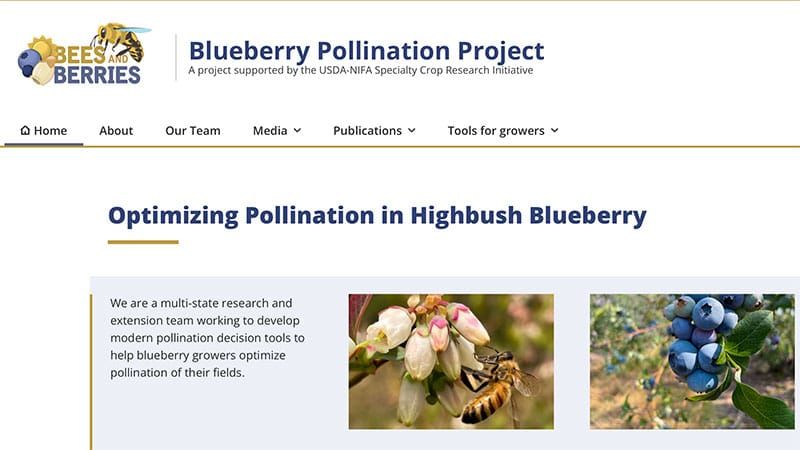
Researchers at five universities worked for more than five years to develop a tool that helps blueberry growers find the sweet spot on the number of bees needed for a good pollination.
The Blueberry Pollination Project, which went live in its current form about a month ago, provides tools, along with a wealth of factsheets and publications, that helps guide blueberry growers.
The project offers two tools that will help growers – a Bloom Timing Tool and a Stock Density Tool – that will provide information to help growers prepare for the season.
The Stock Density Tool will provide guidance to prevent a grower from using too many bees.
“Hopefully it will give them confidence to lower their stock density and give a good pollination,” said Lisa DeVetter, a professor of horticulture with Washington State University, one of the researchers who helped develop the pollination project.
She added that growers need to know the quality of the hives.
"It's not the number of hives, but it's the strength or population to consider," DeVetter said.
The Bloom Timing Tool will help growers estimate the start, midpoint and end of blooms to coordinate hive arrival, DeVetter explained.
She works out of the WSU research and extension facility in Mount Vernon. DeVetter said growing blueberries is challenging in the Pacific Northwest. In addition to blueberry blooms not being well designed for honeybee pollination, she said springtime often provides suboptimal growing conditions.
Washington is the largest blueberry grower in the United States. The United States Department of Agriculture stated that Washington produced more than 200 million pounds of blueberries in 2024.
DeVetter conducts research in cooperation with commercial growers in Skagit and Whatcom counties. The USDA agriculture census dated 2022 showed that Whatcom County had 186 blueberry farms growing on 7,196 acres and Skagit County had 64 blueberry farms growing on 1,856 acres.
Washington state has more than 900 farms growing blueberries on 18,332 acres, according to the census.
The Blueberry Pollination Project formed in 2020 with horticulturists, entomologists, apiculturists, plant breeders, economists and social scientists, according to the project’s website. The purpose is to conduct a cost-benefit analysis of honeybee stocking density and placement strategies and develop recommendations for growers.
Five universities – Washington State University, University of Florida, Michigan State University, Oregon State University and Ghent University (Belgium) – participated in the project.
USDA funded the project, which was completed in 2025. DeVetter said the group hopes to find additional funding to pay for expanded research. The group has been getting questions about resiliency and other pollinators.