Farm-to-restaurant connection in Puget Sound strengthens
Businesses look to farming neighbors to provide fresh local grains for their tortillas, breads and pastries.
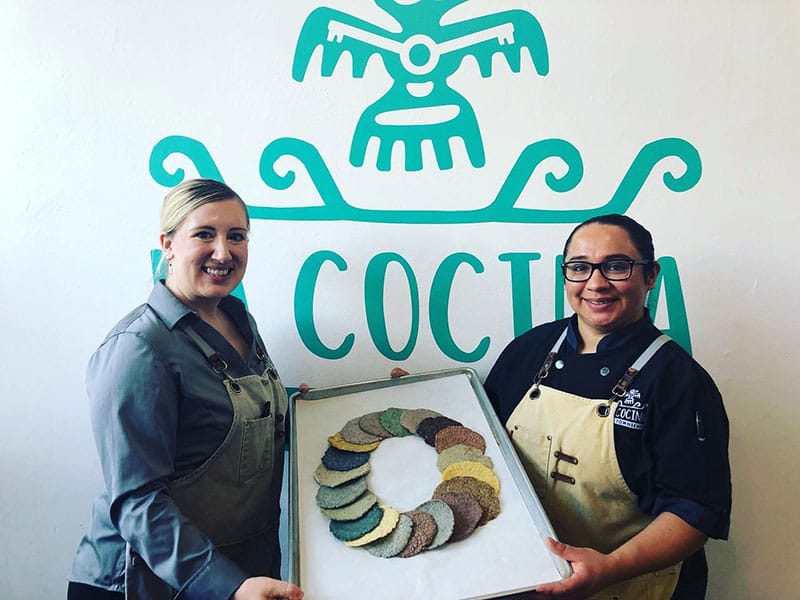
Cassie and Lissette Garay, owners of La Cocina in downtown Port Townsend, are busy moving into a new space that will give them a larger space to operate.
The backbone of their restaurant, which emphasizes simple, fresh Mexican cuisine, is the corn and flour tortillas they make using grain grown on the Olympic Peninsula.
La Cocina is one of the businesses partnering with local farms to provide grains for their dishes. They work with Chimicum Workhorse Project for corn and with Chimicum Valley Grainery for wheat.
Cassie said the relationship allows money to go directly to farmers and the community relationships established has been beneficial. She works with local farmers on the types of grains to grow.
“We’ve been able to select different varieties of corn that we’ve liked,” Cassie said. “I don’t think we’d get that if it’s grown outside of our region.”
She explained that Port Townsend is home to a huge vegan and gluten-free community. “It’s great to say it’s just made with corn. It’s great to know what is actually in our food products.”
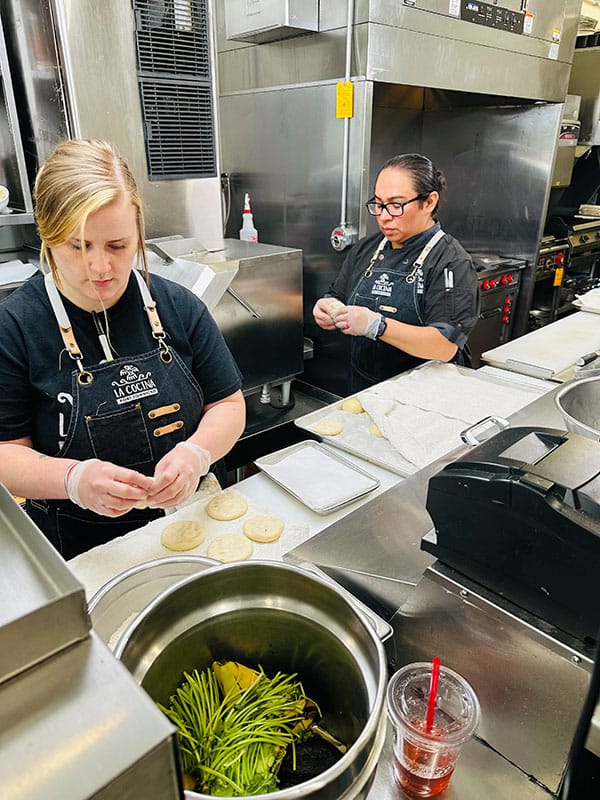
La Cocina received assistance from the Washington State Department of Agriculture to help buy new equipment. The restaurant received $31,350 in a Local Food Infrastructure grant (see information at end of story), a reimbursement-style grant than funded the purchase of tortilla-production equipment.
Two other bakeries in the region, Fernhorn Bakery on Vashon Island and Little Red Hen Bakery in Coupeville on Whidbey Island also received funding through the food infrastructure grant program.
Owner Thomas Vroom works with Bluebird Grain Farms in Winthrop, Chimacum Valley Grainery and farms east and west of the Cascades.
“It’s a lifelong passion and belief that eating local is much better, Vroom said. He uses a mill provided by the Vashon Island Growers Association to process the grains. “It gives me a fresher product that is more nutrient dense.”
He said the mill is community owned and 10 percent of the flour he produces goes to the food bank.
He is using the $25,553 grant to purchase equipment to meet increasing demand for his goods.
Like Fernhorn and La Cocina, Little Red Hen Bakery, located in Coupeville on Whidbey Island, works with a local farm, Ebey Road Farm, to provide some of the grain they use. Owners Tyler and Sara Hansen also buy from Chimacum Valley Grainery and Cairnspring Mills in Skagit County to provide local grains and flours.
“It’s nice to have that partnership with the community,” Tyler said. “You have more control over your product.”
Little Red Hen Bakery is going through an expansion that will add 1,200-sqare-feet to the building located near Coupeville’s waterfront. Little Red Hen received $53,500 to fund the installation of a stone mill that will expand the bakery’s production capabilities.
Tyler Hansen said the renovation will help streamline operations and get them to the goal having 50 percent of production coming from Whidbey Island-grown grains.
Chimacum Valley Grainery, located south of Port Townsend, is an organic family farm that also has a stone mill, wood-fired bakery and a craft micro-brewery, according to its website.
Cairnspring Mills, based in Burlington, works with farmers in the Skagit Valley, eastern Washington and northeast Oregon.
“There are sustainability and regenerative requirements to supply Cairnspring, but the foundation is a partnership,” said Kevin Morse, co-founder and CEO, in an email. “Our farmers care about grain quality and about taking care of their soil for the long haul.”
Because Cairnspring is stone-milling and incorporating all parts of the wheatberry, the flour brings character to whatever someone is making, he explained. There’s no additives, it’s not enriched, or bromated, which is something that can’t be found in commodity flour.
“We’re encouraged. There’s a real shift happening; more bakers, chefs, and home cooks are paying attention to where their ingredients come from, and that’s created genuine demand for what we’re doing,” Morse said.
$3.4 million in grants awarded to strengthen Washington State’s local food system
Washington State Department of Agriculture (WSDA) awarded $3.4 million in Local Food System Infrastructure Grants to unlock new sales channels for local farmers, lower costs for small businesses through efficiency improvements and increase consumer access to healthy, high-quality and culturally relevant foods. There were 276 applications submitted, with requests totaling over $16 million— more than five times the available funding.
Laura Raymond, manager of the WSDA Regional Markets Program, explained that “these grant projects tackle persistent infrastructure barriers faced by local producers that restrict their ability to sell to schools and other markets in their community. We look forward to continuing to support rural farm economies and ensuring a level playing field for our vital small farms and food businesses. Each one of the 276 applications represents an opportunity to do this.”
WSDA awarded a total of 82 projects across 31 counties, with grant amounts ranging from $13,019 to $75,000. These projects will enhance food safety, increase food processing efficiency, expand food distribution capacity and promote the availability of Washington grown, caught and raised foods.
Derek Sandison, Director of the Washington State Department of Agriculture, stated “These grant investments are ensuring food business entrepreneurs remain engines for innovation, growth and sustainability in Washington’s vibrant local food economy. The high demand for Regional Markets programs is a testament to the continued need for this scale of investment in our local food system.”
Local Food System Infrastructure Grants are projects of the Regional Markets Program that contribute to WSDA’s Focus on Food Initiative, ensuring that safe, nutritious food is effectively produced and distributed throughout Washington.
For future grant opportunities, visit agr.wa.gov/grants.